Best Audio Interface for Home Studio: 2026 Buying Guide
- Audio Interface, Buying Guides
- by Bruno Bontempo
Find the best audio interface for home studio recording in 2026. Compare 5 tested options for every budget, with hands-on testing and practical recommendations.
Best Audio Hub tests and reviews audio interfaces. Our articles may include affiliate links and we may earn a commission. Read more about how we evaluate products.
Table of Contents
Introduction
Choosing an audio interface means navigating through endless technical specifications, marketing claims, and price points. As your studio’s heart, this choice will impact everything from your recording quality to your creative workflow.
I’ve tested these 5 audio interfaces in real home studio conditions – recording vocals, mixing with plugins, tracking guitar and bass, and working with MIDI instruments. My focus wasn’t just on specs, but on how they perform in actual recording sessions, their reliability during long projects, and their effect on creative flow.
Moreover, I’ve evaluated them across different setups and recording scenarios, so you’ll know exactly how each interface handles various microphones, instruments, and monitoring situations. Let’s find the perfect match for your studio.
| QUICK OVERVIEW
Best Overall
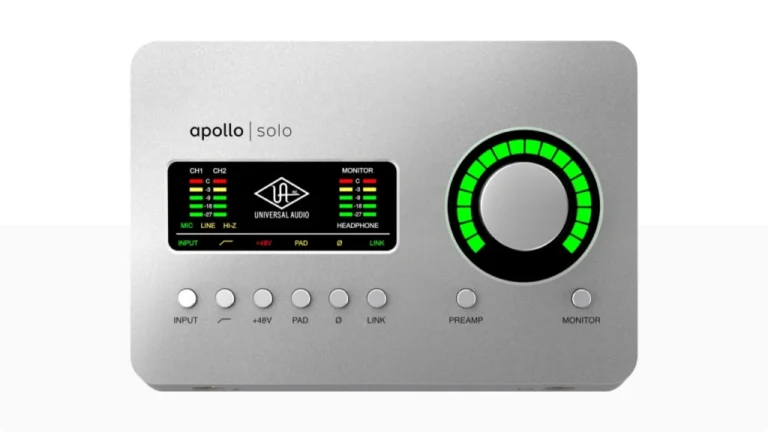
Apollo Solo
4.7
The Apollo Solo brings professional studio quality to your home setup. The combination of high-end Unison preamps and built-in UAD processing makes it possible to record through legendary studio gear emulations with virtually no latency.
| Key Features
- Inputs: 2x XLR/TRS combo, 1x Hi-Z instrument
- Outputs: 2x TRS, 1x Headphone
- Resolution: 24-bit/192kHz
- Compatibility: Mac, Windows (Thunderbolt 3)
- Plus: UAD-2 DUO Core processing, Unison preamp technology
| Why to buy
- Recording vocals with vintage preamp emulations (particularly useful for modern pop and hip-hop vocals)
- Guitar tracking with amp simulations with zero monitoring delay
- Mastering projects that benefit from UAD's SSL bus compressor
- Voice-over work requiring real-time processing with UAD
- Podcasting setups where monitoring effects are crucial
- Electronic music production using UA's synth emulations
👉 Note: UAD (Universal Audio Digital) are high-quality audio plugins and hardware, known for accurately emulating classic analog equipment. These plugins are compatible with major DAWs and run natively on computers with UA hardware for near-zero latency.
| Why to avoid
- Drum recording requiring more than two inputs
- Band rehearsal recording needing multiple headphones
READ FULL REVIEW
Overview: The Apollo Solo’s performance in real-world recording scenarios sets it apart from typical interfaces. The preamps deliver 62dB of gain, plenty for gain-hungry microphones like the Shure SM7B.
When tracking vocals through the Neve 1073 emulation, the Unison technology physically adjusts the preamp’s impedance and gain staging – you can hear the difference in harmonic content and depth. The round trip latency stays under 2ms at 96kHz buffer size, making it possible to record through UAD plugins without perceptible delay.
The headphone amp drives even high-impedance headphones with authority, and the monitor controller includes a mono switch for checking phase issues. The input metering is precise, with clear indication before clipping occurs. The metal chassis feels substantial, and the knobs have a smooth, precise action without wobble.
💡 In a Nutshel:Apollo Solo makes your recordings sound like they were done in a professional studio. You can record through classic gear simulations without any delay, and everything from quiet vocals to loud guitars comes through crystal clear.
Best Value
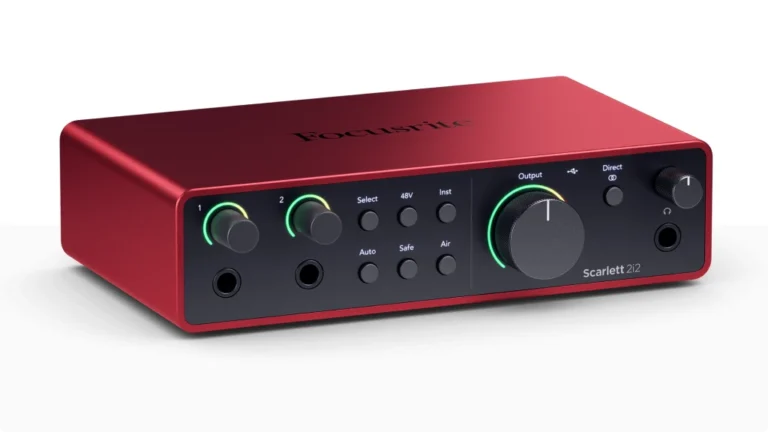
Scarlett 2i2 4th Gen
4.5
The Focusrite Scarlett 2i2 delivers professional-grade audio quality without unnecessary complexity. The preamps capture every detail, and the direct monitor function lets you hear yourself without any computer processing delay.
| Key Features
- Inputs: 2x XLR/TRS/Hi-Z combo
- Outputs: 2x TRS, 1x Headphone
- Resolution: 24-bit/192kHz
- Compatibility: Mac, PC or iPadOS
- Plus: Air mode, Direct Monitor switch, Software bundle
| Why to buy
- Recording acoustic guitar and vocals simultaneously with different gain requirements
- Streaming setups requiring both XLR mic and instrument inputs
- Producers working with virtual instruments and MIDI
- Vocal recording benefiting from the Air mode's presence boost
- Podcasters needing zero-latency monitoring for guest
- Mobile recording sessions where reliability is crucial
| Why to avoid
- Studios needing ADAT expansion
- Setups needing MIDI I/O
READ FULL REVIEW
Overview: The 4rd gen Scarlett 2i2’s preamps provide up to 56dB of clean gain, handling everything from loud guitar amps to quiet spoken word.
The Air mode adds a noticeable lift around 3-4kHz that works particularly well on vocals and acoustic guitars – it’s similar to the high-end presence you get from boutique preamps. The converters are notably clean, with a dynamic range of 110dB.
The direct monitor circuit has zero latency and includes a stereo/mono switch. The gain halos provide instant visual feedback – green means signal, orange suggests optimum level, and red indicates clipping.
The interface maintains stable performance at 96kHz with a 128-sample buffer size, achieving round trip latency under 4ms. The USB-C connection is more stable than previous generations, and the all-metal chassis has withstood countless studio sessions.
💡 In a Nutshell: The Scarlett 2i2 gives you professional sound without the complexity. The Air mode makes vocals and acoustic instruments sound more expensive than they are, and you won’t hear any delay when recording

Budget Winner
Universal Audio Volt 2
4.4
The Volt 2 brings Universal Audio’s recording expertise to an affordable price point. The vintage mode adds warmth to digital recordings, making them sound more like analog recordings.
| Key Features
- Inputs: 2x XLR/TRS/Hi-Z combo, MIDI I/O
- Outputs: 2x TRS, 1x Headphone
- Resolution: 24-bit/192kHz
- Compatibility: MacOS, Windows, iPad, iPhone
- Plus: Vintage Mic Preamp mode, Software bundle
| Why to buy:
- Home recording projects needing vintage preamp character
- Beat producers recording vocal and instrument overdubs
- Gaming streams requiring both mic and instrument inputs
- Vocal recording benefiting from the 610 tube emulation
- Project studios needing reliable USB-C connectivity
- Mobile setups where bus power is essential
| Why to avoid
- Setups requiring ADAT expansion
- Studios needing advanced routing options
READ FULL REVIEW
Overview: The Volt 2’s preamps deliver 58dB of gain, which is impressive at this price point. The Vintage mode replicates the behavior of UA’s classic 610 tube preamp, adding subtle harmonics that work particularly well on vocals and bass. The preamps maintain their clarity even at high gain settings, with minimal noise floor increase.
The direct monitoring is implemented through a simple knob that balances between input and DAW playback. The round trip latency at 96kHz with 128 samples buffer is around 4.5ms, perfectly usable for real-time monitoring through DAW effects.
The LED meters are accurate and responsive, making it easy to set proper recording levels. The unit is USB-powered but provides enough current for phantom power on both channels simultaneously.
💡 In a Nutshell: The Volt 2 brings expensive-sounding quality to a budget price point. The Vintage mode makes recordings sound warmer and more professional, similar to old-school studio gear. You get clear sound even with quiet microphones.
Best for Expandability
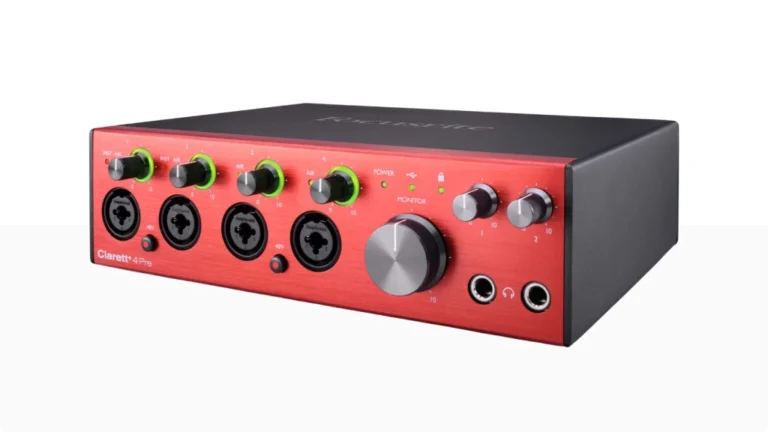
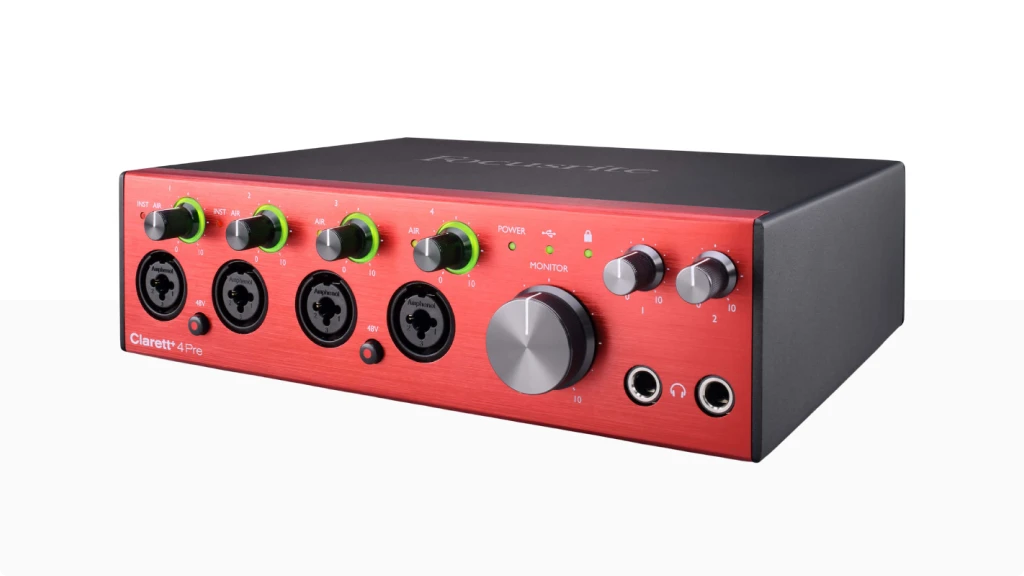
Focusrite Clarett+ 4Pre
4.6
The Clarett+ 4Pre is built for growing studios. With ADAT expansion, you can add eight more channels when needed, perfect for recording full bands or drum kits.
| Key Features
- Inputs: 4x XLR/TRS/Hi-Z combo
- Outputs: 4x TRS, 1x Headphone
- Resolution: 24-bit/192kHz
- Compatibility: MacOS, Windows and iPadOS
- Plus: ADAT expansion, Four Clarett+ Preamps with Air Mode, Software bundle
| Why to buy
- Full band recording sessions using ADAT expansion
- Multi-mic drum recording with phase-coherent preamps
- Project studios requiring multiple simultaneous headphones
- Vocal recording sessions utilizing the sophisticated Air mode
- Studios needing flexible routing for external effects
- Podcasting setups with multiple guests
👉 Note: ADAT is a digital interface on the Clarett+ 4Pre that expands input capacity, adding up to 8 channels at 48kHz or 4 at 96kHz. Perfect for larger setups, it integrates additional preamps or interfaces seamlessly, ensuring high-quality audio and versatile connectivity.
| Why to avoid
- Home recording setups not needing extra I/O
- Mobile recording where compact size is crucial
Overview: The Clarett+ 4Pre’s preamps offer 57dB of gain with an impressively low noise floor (-128dB EIN). The Air mode here is more sophisticated than the Scarlett series, modeling the ISA 110’s transformer-based circuit.
The resulting sound has more depth in the low mids and a natural high-end lift. The converters achieve 118dB dynamic range, capturing every detail of dynamic sources.
The direct monitoring system includes a software mixer for creating custom cue mixes. At 96kHz with a 128-sample buffer, round trip latency stays under 4ms. The ADAT input allows for eight additional channels at 48kHz (four at 96kHz).
The dual headphone outputs have independent level controls and can receive different mixes. The build quality is professional grade, with all-metal construction and firm, smooth-turning knobs.
💡 In a Nutshell: The Clarett+ 4Pre is like a studio that grows with you. The preamps make everything sound natural, and you can add more inputs when you need them. It handles multiple headphones easily, and the sound quality matches interfaces costing much more
Best for Portability
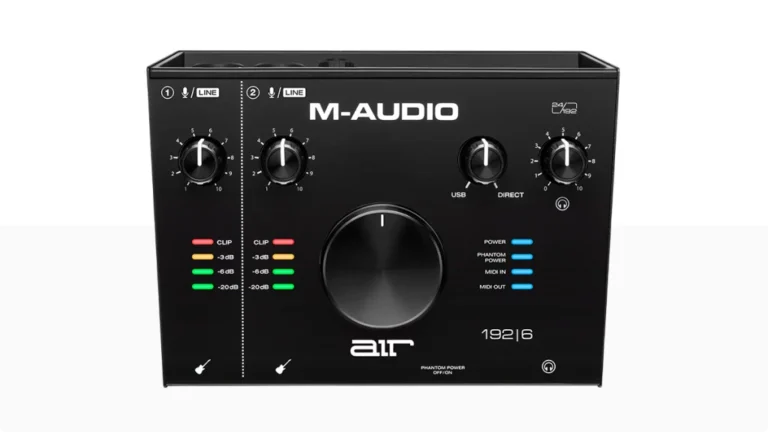
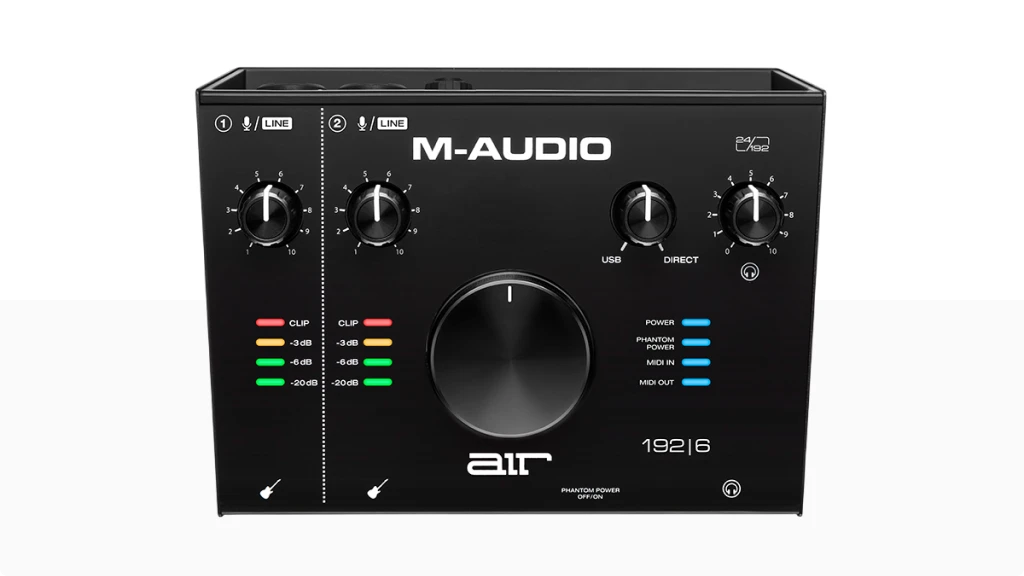
M-Audio AIR 192|6
4.5
The AIR 192|6 combines compact design with professional features. It’s built for musicians who need quality recording capabilities on the go.
| Key Features
- Inputs: 2x XLR/TRS combo, 2x Hi-Z, MIDI I/O
- Outputs: 2x TRS, 1x Headphone
- Resolution: 24-bit/192kHz
- Compatibility: MacOS, Windows
- Plus: Crystal preamps, Software suite
| Why to buy
- Location recording sessions requiring compact setup
- Podcasting with condenser microphones
- Streamers needing a reliable portable interface
- Singer-songwriters recording in different venues
- Project studios with limited desk space
- Electronic musicians working with laptop-based setups
| Why to avoid
- Sessions needing multiple headphone outputs
- Projects requiring extensive routing options
READ FULL REVIEW
Overview: The AIR 192|6’s Crystal preamps provide 55dB of gain with a notably clean character. The preamps perform particularly well with condenser microphones, maintaining clarity in the high frequencies without harshness.
The Hi-Z input has higher impedance than typical interfaces, preserving the full frequency response of passive guitar pickups.
The direct monitoring circuit includes a mono switch useful for checking phase issues. The round trip latency at 96kHz/128 samples is around 4.8ms. The USB-C connection provides stable power and data transfer, even on laptops. The chassis is metal but compact enough to fit in a laptop bag.
The input/output knobs are recessed to prevent damage during transport, and the rubber feet keep it stable on any surface.
💡 In a Nutshell: The AIR 192|6 is your studio-to-go. It’s built tough enough to survive regular travel while still delivering professional sound quality. Everything from microphones to guitars sounds clean and clear, and it just works without fuss.
Comparison Table
| Feature | Apollo Solo | Scarlett 2i2 | Volt 2 | Clarett+ 4Pre | AIR 192|6 |
|---|---|---|---|---|---|
Category |
Best Overall |
Best Value |
Budget Winner |
Best for Expandability |
Best for Portability |
Inputs |
2x XLR/TRS combo, 1x Hi-Z |
2x XLR/TRS/Hi-Z combo |
2x XLR/TRS/Hi-Z combo, MIDI I/O |
4x XLR/TRS/Hi-Z combo |
2x XLR/TRS combo, 2x Hi-Z |
Outputs |
2x TRS, 1x Headphone |
2x TRS, 1x Headphone |
2x TRS, 1x Headphone |
4x TRS, 2x Headphone |
2x TRS, 1x Headphone |
Resolution |
24-bit/192kHz |
24-bit/192kHz |
24-bit/192kHz |
24-bit/192kHz |
24-bit/192kHz |
Compatibility |
Mac, Windows (Thunderbolt 3) |
Mac, PC or iPadOS |
MacOS, Windows, iPad, iPhone |
MacOS, Windows and iPadOS |
Mac, Windows |
Plus |
UAD-2 DUO Core, Unison preamp |
Air mode, Direct Monitor, Software bundle |
Vintage Mic Preamp, Software bundle |
ADAT expansion, Air Mode, Software bundle |
Crystal preamps , Software suite |
Choosing the Best Audio Interface for Home Studio
Your audio interface is the foundation of your home studio. Over the years, I’ve learned that choosing the right interface isn’t just about specifications – it’s about how it fits into your creative process. Here’s what really matters:
Recording Quality and Preamps
The preamp quality directly impacts your recordings. While all modern interfaces offer decent technical specifications, their preamps color your sound differently:
- Clean preamps (like in the Clarett+ 4Pre) work well for acoustic instruments and vocals where you want to capture natural sound
- Colored preamps (like the Volt 2’s Vintage mode) can add character to your recordings, reducing the need for processing later
- High-gain preamps are essential if you use gain-hungry microphones like the SM7B or ribbons
Workflow and Creativity
Your interface should enhance your creative process, not interrupt it. Consider these workflow factors:
- Direct monitoring lets you record without latency, crucial for maintaining your performance feel
- Physical controls for monitor volume, headphone level, and input gain allow quick adjustments while recording
- Multiple headphone outputs help when recording with others
- Software integration with your DAW can speed up your workflow
Future-Proofing Your Studio
Your needs will likely grow as your studio develops:
- ADAT expansion ports allow adding more inputs later (crucial for drum recording)
- Multiple outputs enable external hardware integration
- Higher sample rates support professional delivery requirements
- Quality of drivers and stability matter more as your projects grow
Real-World Performance Factors
Beyond specifications, consider these practical aspects:
- Driver Stability:
- Stable drivers prevent crashes during recording
- Regular manufacturer updates ensure compatibility
- Low-latency performance affects your ability to use software monitoring
- Software Integration:
- Included DAW software can save you money
- Plugin bundles add value and creative options
- Control panel software affects your daily workflow
- Build Quality:
- Robust construction ensures longevity
- Quality knobs and switches prevent noise issues
- Port durability matters with frequent cable changes
Understanding Your Creative Needs
Match the interface to your primary recording tasks:
- For Singer-Songwriters:
- Two quality preamps are usually sufficient
- Good headphone amp for monitoring
- Direct monitoring for zero-latency tracking
- For Beat Producers:
- Clean conversion for virtual instruments
- Low latency for MIDI work
- Reliable drivers for plugin-heavy sessions
- For Band Recording:
- Multiple inputs or expansion options
- Several headphone outputs
- Flexible routing capabilities
- For Content Creators:
- Simple, reliable operation
- Good USB connectivity
- Easy integration with streaming software
Technical Requirements
Understand these specifications in practical terms:
- Sample Rate and Bit Depth:
- 24-bit/96kHz is sufficient for most projects
- Higher rates mainly matter for professional work
- Consider storage space and computer processing power
- Connection Type:
- USB is universal but can have higher latency
- Thunderbolt offers better performance but costs more
- Consider your computer’s ports and future upgrades
- Power Requirements:
- Bus-powered units offer better portability
- External power supplies provide more headroom
- Some features require external power
Budget Considerations
Think about the total investment:
- Factor in needed cables and stands
- Consider included software value
- Remember that preamp quality affects how much processing you’ll need
- Weigh the cost of future expansion needs
Final Thoughts: Making the Right Choice for Your Home Studio
Each interface in this guide serves specific needs in the home studio environment. The Apollo Solo leads with professional features and near-zero latency. The Scarlett 2i2 balances quality and value perfectly. The Volt 2 makes high-quality recording accessible to beginners. The Clarett+ 4Pre grows with your studio, and the AIR 192|6 serves mobile recording needs effectively.
Here’s how to match your specific requirements with the right interface:
For Professional Home Studios
The Apollo Solo stands as the top choice when audio quality and processing power are crucial. Its Unison preamps and UAD plugins create a professional-grade recording chain. For a high-end alternative, the Apogee Duet 3 offers comparable sound quality with its advanced converters and mic preamps, though without the DSP processing.
For Growing Studios
The Focusrite Clarett+ 4Pre provides room for expansion while maintaining professional quality. The MOTU M2, though having fewer inputs, competes in this space with its excellent conversion quality and detailed metering – particularly useful for precision recording work.
For Value-Conscious Producers
The Scarlett 2i2 4th Gen delivers professional features at a mid-range price point. The Behringer U-Phoria UMC204HD offers similar features at a lower price point, with surprisingly good preamps and build quality. The Scarlett Solo 4th Gen provides the same preamp quality as the 2i2 in a single-input format, perfect for solo artists.
For Budget Setups
The Universal Audio Volt 2 brings UA’s preamp expertise to an affordable price point. The Behringer U-Phoria UM2 and M-Track Solo serve as viable entry points for beginners, with the UM2 offering particularly good value for basic recording needs.
For Mobile Recording
The M-Audio AIR 192|6 excels in portable setups. The MOTU M2 also works well here, with its detailed metering being particularly useful in varying recording environments.
Remember that while affordable budget interfaces have improved dramatically, investing in better preamps and converters pays off in reduced post-processing needs. The Apollo Solo and Apogee Duet 3 represent the high end, where the investment brings tangible quality benefits. The Scarlett line and MOTU M2 hit the sweet spot of quality and value. The Behringer options and M-Track Solo make good starting points for beginners.
RELATED
FAQ
What does an audio interface actually do for my home studio?
An audio interface converts your analog sound (like vocals or guitars) into digital signals for your computer, and back again for monitoring. It’s essential for professional recording quality and low-latency monitoring.
What makes an audio interface good for home studio recording?
A good home studio audio interface combines low latency, quality preamps, and appropriate I/O for your needs. The interface should have phantom power for condenser microphones and direct monitoring for zero-latency recording.
Do I need to spend a lot on an audio interface for home studio?
Not necessarily. While professional interfaces offer additional features, you can find quality options under $/€100 that deliver good results for basic recording needs. The key is matching the interface to your specific requirements.
Do I need an audio interface with MIDI for my home studio?
Not necessarily. Most modern MIDI keyboards connect directly via USB. However, if you have older MIDI equipment or plan to expand your studio, interfaces with MIDI I/O provide useful connectivity options.

I've been recording, producing, and playing bass for over 20 years—from touring with my first band at 15 to playing progressive metal across Europe today. Through multiple albums, projects (Madness of Light, Rising Course, Roots of Ascendant, Human|Archive), and production work, I've tested audio interfaces in every scenario imaginable. At Best Audio Hub, I combine my historian background with years of hands-on music and audio experience. No marketing fluff—just honest insights from someone who's been in the trenches.
| ALSO REVIEWED